The Rise of Server Blades

The Server Blades is the fastest growing segment of the worldwide server market. It is expected to continue to grow at a higher rate according to Industry analysts and researchers. Project venture data centers seek out to these servers which provide benefits to companies. Benefits of the new platform include power cooling, and server consolidation that maximize the compute power per rack unit. As a result, effectively incorporating these devices into the data center system construction becomes an important element for the system administrators to consider.

The advantage of Blade servers is that it offers a consistent method of deploying multiple memory, processors, and I/O resources. Hence, it replaces those resources on plug-in boards that slip into a standard chassis. They share common resources like power, storage and I/O across multiple processors thereby reducing cost versus separate server systems. In the server market, the demand for blade servers has rapidly increased with time. IT departments have encountered their ultimate vehicles to increase server density. They are also achieving higher control over operation, deployment, provisioning and advancing large server farms. What has made Blade servers so alluring is the fact that they offer a permutation of reduced cost, competent use of costly data center space, cut down management for various servers, and greater performance over time.

Blade servers are the recipient force behind several key elements of computing technologies. All of it ranging from inflated processor densities in single-chip multi-core semiconductors, to bunch computing techniques, and 10 GB Ethernet deployments.

Data center managers are making the best use of Blade servers’ various capacities. The ability of the servers to deeply increase both the quantity and the competence of computing, memory and I/O resources is a boon to data centers. These services increase the ever demanding user productivity. It has given an augment to a new set of software tools, both in server resource management and server desktop virtualization applications. In addition to this, the rising densities of blade server-based data centers has led to the growth of a fresh set of challenges in the power and cooling of contemporary data centers. As a result, power vendors are forced to extend new technologies and solutions for power management and efficiency.

Server blades include two major technologies – integrated switches and pass-through technologies.

Integrated Switches

Blade systems permit built-in switches to manage traffic flow between the blade servers within the chassis and the remaining enterprise network. Blade systems provide a variety of switch media types that includes the following:
• In-built Ethernet switches
• Infiniband switches
• Fiber conduit switches

Integrated switches are a passage to the blade servers inside the chassis and the data center. Every blade server is connected to a backplane or a mid-plane that normally contains four committed signalling lane to redundant network devices dwelling in the chassis. This definite physical structure decreases the number of cables necessary by each server and supplies a level of resiliency, which is done through the physical redundancy of the system interface controllers (NICs) and I/O system devices.

Pass-through Technology

 It is a substitute method of network connectivity that permits individual blade servers to correspond openly with external resources. In this technology, both copper and optical pass-through modules that supply access to the blade server controllers are offered. There are two common types of pass-through I/O devices, each of which provides connectivity to the blade servers through the backplane or the mid-plane of the chassis. There is a one on one relationship amid the number of server interface amongst the numeral peripheral ports in the access deposit. These server interfaces are required to maintain the blade system.

Pass-through components are passive devices that casually expose the blade server NIC to the external network. They do not need configuration by the network administrator. Also I/O devices are not required in these configurations. It is also not extended to network Layer 2 or Layer 3 topologies. In addition to this, the blade servers may utilize any of the NIC teaming configurations sustained by their drivers. The necessity to decrease the amount of cabling in the data center is the most essential influence driving the swift implementation of blade servers.

Pass-through modules never allow the data center to take added benefit of the cable consolidation the blade platform tenders. This short of cable fall out in the rack/ row/ provision frequently hampers the employment of a pass-through foot solution in the data center.

Data Center Talk updates its resources every day. Visit us to know of the latest technology and standards from the data center world.
Please leave your views and comments on DCT Forum


Share on TwitterSubmit to StumbleUpon

Ericsson To Offer Cloud-Based Services

As a part of the cloud services offered by Ericsson, the company is now launching a new package for building and optimizing data centers for a company in Barcelona. Ericsson plans to adopt a new strategy for planning, designing and building data centers and promote a whole cloud computing platform that includes management and security.

ericssonThis service is introduced in order to meet the increased demand for cloud based services. Paolo Colella, Head of Consulting and Systems Integration at Ericsson, says: “Operators are ideally positioned to offer high quality, high security and high availability cloud services to enterprises. We bring telecom-grade thinking to the cloud space, focusing both on availability and security of the services, as well as cost and efficiency gains for enterprise customers. And, in addition, cloud services bring new business opportunities for the telecom operators.”

She also adds, “Building a cloud solution will include a number of technological approaches. Within Ericsson’s services organization, we will contribute with our key competence, looking at all of the aspects of the network architecture and how to build, optimize and operate the cloud.”

Ericsson will provide services that include constructing new data centers, and also consolidation, modernization and standardisation of existing data centers. With the cloud strategy, the consumer can reduce capital investment on software licensing, floor space, power and cooling. Because of increased mobility, it is gaining popularity in the market too.

Colella continues: “Ericsson’s global scale and skill, coupled with our experience in delivering more than 1,300 systems integration projects every year and expertise in mobile and fixed connectivity, means we can provide operators with new levels of flexibility and efficiency in their IT systems.”

For more information, visit www.ericsson.com

Data Center Talk updates its news resources every day. Keep up to date with the industry.

To post your views and comments, visit DCT Forum.

Share on TwitterSubmit to StumbleUpon

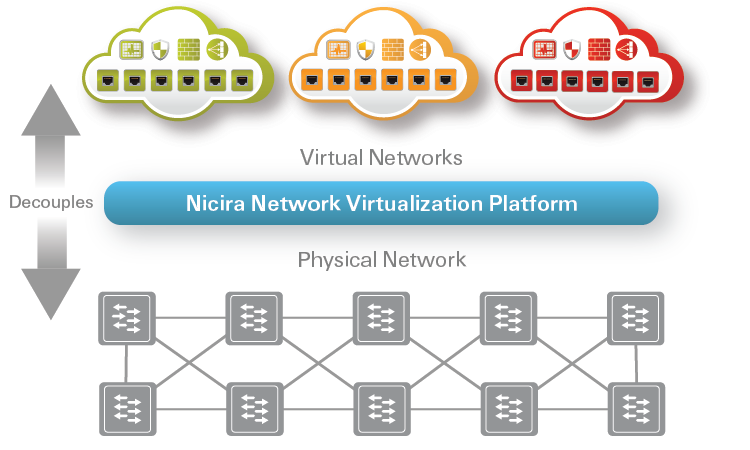
Nicira Network Virtualization Platform Decouples Physical and Virtual Network Infrastructure


Network virtualization company Nicira has publicly unveiled a software-based system that creates a distributed virtual network infrastructure in cloud data centers that is completely decoupled and independent from physical network hardware.Continue Reading …

Share on TwitterSubmit to StumbleUpon